Wang Ruilai: A Study of China in Song Dynasty by Kondo Shinichi
Xushuo
Asked about recent reading. After thinking about it, Professor Kondo Yicheng’s "Research on the Imperial Examination Society in China in Song Dynasty" was deeply impressed after reading it. A few years ago, this book was included in the "Ji Gu Series" by Japan Ji Gu Academy. Jigu Academy can be called "Zhonghua Bookstore" in Japan, and it is well-known in academic circles at home and abroad for publishing classical literature and academic works. This book is a collection of papers published by Kondo in the past 30 years, and it is the crystallization of research so far. Most of the papers included in this book have read the printed copies signed by Kondo at the beginning of publication. Therefore, I have a certain understanding of Mr. Kondo’s academic ideas and research results. The collected works provide a comprehensive view of Mr. Kondo’s academic characteristics and achievements.
In March 2017, 70-year-old Mr Kondo Ichiro will retire from Waseda University, where he has studied and worked for decades. As an old friend who has been in contact for more than 30 years, I would like to introduce this stone from other mountains to domestic academic circles, and take this opportunity to express my respect for Mr. Kondo Ichiro’s hard work in the field of China history research. The following is a review of "A Study of China’s Imperial Examination Society in Song Dynasty", a study of China history between Kondo and Japan, and Kondo and me.

In 2007, the author (left) and Kondo were in izakaya. (The picture in this article is provided by the author)
First, a review of "Research on the Imperial Examination Society in China in Song Dynasty"
"Research on the Imperial Examination Society in China in Song Dynasty" is a collection of papers, just like the usual habits of most Japanese scholars. However, when compiling this book, Kondo didn’t simply pile up according to the publishing sequence like the usual collection of papers, but spent his mind and made a delicate logical reconstruction. The outline of the book is translated as follows.
National system: imperial examination, school system and literati bureaucracy in Song Dynasty
Chapter one: Imperial College and imperial academy in the early Song Dynasty.
Chapter two: A short test of "Qingli New Deal"
Chapter three: Wang Anshi’s imperial examination reform.
Chapter four: Cai Jing’s imperial examination and school policy.
Chapter five: Wang Anshi’s evaluation in the early Southern Song Dynasty.
Chapter six: Three topics of "A Brief Record of the Eighteen Years in Shaoxing"
Regional chapter: the scholar society in qingyuan prefecture and other regions of Mingzhou in Song Dynasty.
Chapter one: Imperial Examination and Confucianism in Southern Song Dynasty.
Chapter two: Wang Anshi, the magistrate of Yinxian County, and Mingzhou Scholar Society.
The third chapter: the scholar society in Xing Wu, Huzhou in the late Song Dynasty and early Yuan Dynasty.
Chapter four: Interpretation of the epitaph written by Wang Anshi-region, contacts and party struggle.
Chapter five: the regional problems in Sichuan provincial examinations in the Southern Song Dynasty.
Chapter VI: Scholar-officials and society in Song Dynasty-Huang Gan’s world of ceremony and judgment.
Personal article: Su Dongpo, a scholar and bureaucrat
Chapter One: Su Dongpo’s Exam.
The second chapter: Zhang Fangping’s Tomb Table of Mr. Wen ‘an and On the Discrimination of Rape.
Chapter Three: Su Dongpo’s Crime —— A Case Study of Wutai Poetry
Chapter four: Su Dongpo’s Huangzhou Cold Food Poetry Volume and the scholar-officials in Song Dynasty.
Chapter Five: Understanding the Achievements of Su Shi in Hangzhou —— A Textual Research on the Bureaucratic Policy of Scholars in Song Dynasty
Chapter Six: A Textual Research on the Elegant Collection of Xiyuan —— The Birth of the Legend of Scholars in Song Dynasty.
The above is the main content of this book except the preface and conclusion. The three parts of the book are neatly composed of six articles. Although they are all micro-specific issues, we can deduce a macro understanding from them. According to the preface, the contents of the three parts are briefly summarized and comprehensively reviewed.
The first national system article, mainly around the establishment of the unique imperial examination system in the Song Dynasty, to investigate some related issues. The Song Dynasty, which grew up from the military domination system in the late Tang Dynasty and the Five Dynasties, has greatly reduced its territory compared with the Tang Dynasty, but it has not become the sixth generation after the Five Dynasties, and the reason why it can continue to dominate as a unified dynasty again should be that it has shifted to the civil administration system without much friction. In principle, civil servants who are indispensable in the civil administration system are selected and appointed from all over the country according to the imperial examination based on personal ability, not on their family status. Mr. Kondo believes that this is the main reason for maintaining the centripetal force of the dynasty. In addition, China’s modern imperial examinations were closely related to the school system. Therefore, especially the central and local public schools existed as a supplement to the imperial examinations, but there was almost no chance to realize their original educational functions. The formation of this state is due to the fact that in the process of establishing the imperial examination system in Song Dynasty, the imperial examination selected by bureaucrats and the schools cultivated by bureaucrats were combined into one. At that time, it was said that the goal was to unify the right to take scholars and the right to raise scholars, but the result of such actions was contrary to the original intention. The issue concerned by the national system is the imperial examination and school system, which are the main reasons for the formation of the imperial examination society.
The second regional chapter, it is about the study of the scholar class and regional society of the protagonist in the imperial examination society. Due to the wide geographical coverage, the investigation questions are more specific, so it is difficult to summarize them, and it is unnecessary to avoid the trouble and introduce them chapter by chapter.
The first chapter, "Imperial Examination and Confucianism in Southern Song Dynasty —— Taking qingyuan prefecture in Mingzhou as an Example", starts with qingyuan prefecture in Mingzhou, which is relatively rich in historical materials, and investigates the increase and decrease of the number of qualified scholars in different regions in different periods, and roughly divides them into three types. That is, from Gaozong dynasty to Duzong dynasty, there are three types: increasing type, decreasing type and maintaining a certain number. Qingyuan prefecture, Mingzhou, is a typical example of increasing type that reached its peak in the Lizong Dynasty. As a bird’s-eye view, which is related to the development of the East Asian sea world, this chapter examines Mingzhou, a newly developed region, and the formation process of its scholar society, due to the collapse of the late Tang Dynasty and the Five Dynasties, the demise of the Northern Song Dynasty and the influx of immigrants from the war in North China.
The second chapter, "Wang Anshi, the magistrate of Yinxian County, and Mingzhou Scholar Society", takes the starting point of the formation of Mingzhou Scholar Society in the Northern Song Dynasty as the object of discussion, and points out that the historical data of later generations have been used indiscriminately to demonstrate the grand occasion of Mingzhou Scholar Society. It is believed that the so-called "Mr.five statue of Qingli" in Mingzhou is a historical image fabricated in the second half of the Southern Song Dynasty, when Mingzhou Scholar Society was established and flourished, as a need to tell its own history and legend. Of course, this kind of regional historical image created by the regional scholar society is not just fiction. Although it is different from the form at that time, it also presents the relationship between historical understanding and historical facts.
The third chapter, Scholar Society in Xing Wu, Huzhou at the end of Song Dynasty and the beginning of Yuan Dynasty, takes Huzhou, which is the opposite of Mingzhou, as an example to investigate the reasons for its decline. Taking Zhao Mengfu’s "Quehua Autumn Color Map" as a clue, this paper reviews the relationship between them. Zhao Mengfu, who ate Song Lu first and then became an official, kept in touch with, who had a thorough position of refusing to be an official. Different from Mingzhou, a newly developed place, Huzhou has been famous for its beautiful scenery since ancient times. A large number of famous families and scholars live or live here, seeking happiness in life from their love of traditional culture such as piano, chess, calligraphy and painting. For them, the official position is necessary, but it takes a long time to prepare for the exam, and there are still uncertain factors, so they expect to be an official in a reliable and relaxed way. In this chapter, it is inferred that the general atmosphere of scholar society is the gradual decrease of qualified people. The investigation showed another aspect of scholars in the imperial examination society in the Southern Song Dynasty.
The fourth chapter, Interpretation of Epitaphs Written by Wang Anshi-Region, Network and Party Struggle, is a quantitative investigation of 112 epitaphs and epitaphs collected by Wang Anshi in Linchuan Collection. In this chapter, the establishment of historical materials of stone carvings in Song Dynasty is brought into view, and the consciousness of regional belonging, interpersonal relationship and party consciousness of scholars in Northern Song Dynasty shown in Wang Anshi’s epitaph writing is investigated. The imperial examination society is the framework of Wang Anshi’s epitaph. It should have been an epitaph buried in the tomb to convey the achievements of ancestors to future generations forever. At that time, as a scholar-bureaucrat’s work, it was widely read by contemporary people. From this situation, we can also observe a side of the scholar society in Song Dynasty.
The fifth chapter, "Regional Issues in Sichuan Provincial Examinations in Southern Song Dynasty", discusses the existence of the imperial examination in a special environment and investigates the regional nature of the imperial examination society. Kondo believes that regionality is not only a problem of scholar society, but also related to the national form of the Southern Song Dynasty.
The sixth chapter, Scholar-officials and Society in Song Dynasty-Huang Gan’s Ritual World and Judgement World, as a case study of scholars, takes Huang Gan, Zhu Xi’s disciple and son-in-law, as an example. While tracing back to his career, he also discussed the establishment of Zhuzi’s social status, the concept and reality of scholar-officials. What is the relationship between Huang Gan’s appearance of scholars and the general direction of the times? And how did it affect the history of future generations? If we further focus on the cross-sectional structure of these scholars in the regional society in the mid-Southern Song Dynasty, and compare it with the society in the Northern Song Dynasty, is its structure a homogeneous thing that has existed on the extension line since the Northern Song Dynasty? Or is it regarded as a change in the mature form of the northern song society, although it is on the continuous line of the northern song dynasty? Or is it a social form with some new elements that only appeared in this period? Through the case of Huang Gan, a scholar, Mr. Kondo raised a series of important questions, all of which are important topics related to determining the historical nature of this era. This shows that the study of the imperial examination society in Song Dynasty is still a long way to go in Xiu Yuan.
The third personal article, all around the discussion of Su Shi, can be described as a unique Su Shi theory. Su Dongpo, one of the top eight poets in the Tang and Song Dynasties and a representative poet in the Song Dynasty, is not only a typical scholar, but also a scholar-bureaucrat who achieved a bachelor’s degree in Hanlin and a position as an official in the Ministry of Rites. As a bureaucrat, he himself did not expect that he would be involved in the whirlpool of party struggle between the old and new factions, and was regarded as the leader of one side, who continued to bump in the political waves for a lifetime and was exiled twice. Su Shi, who belongs to the top of the imperial examination society, played his talents in many aspects. His research is closely related to the scholar-bureaucrat society and culture. From the imperial examination to the achievement in Hangzhou, from Wutai poetry case to the theory of distinguishing traitors, from Huangzhou cold food poetry volume to Xiyuan elegant collection, it is centered on specific characters and has a wide range of radiation. Kondo also has his own conclusions about some controversial events. For example, the pseudograph of "On the Discrimination of Rape" said that Kondo thought it could not be established.

A Study of the Imperial Examination Society in China in Song Dynasty
After the publication of A Study on the Imperial Examination Society in China in Song Dynasty, there was an interesting discussion among scholars about the title of this book. Some people say that the word "China" in the title of the book is redundant, while others refute that it was intentionally added by Kondo. I haven’t confirmed this question with Kondo, but my opinion is that it is the latter, and it is Mr. Kondo’s intention. "China in Song Dynasty" refers not only to Chinese mainland in this era of Song Dynasty, but also to a coordinate determined in the long history Song China. Based on this coordinate, Kondo made a profile survey of China’s imperial examination society under the broad vision of general history.
It is not usually from the perspective of class division, but from the clue of the concept of distinction between ordinary and ordinary that runs through the history of China, Kondo examines the China society that has undergone tremendous changes from the late Tang Dynasty to the Five Dynasties and the Song Dynasty. The ultimate goal is to clarify the system reproduction structure of the traditional dynasty for nearly a thousand years. For such a difficult and complicated subject, Kondo took the imperial examination as the key to the reproduction of the dynasty system, and focused on such specific issues as the formation and development of the imperial examination society and culture he was familiar with, thus avoiding vague discussions, and the process and situation of the reproduction of the dynasty system were clearly revealed through the Song Dynasty. This investigation provided a premise and laid a foundation for investigating the imperial examination society in China after the Song Dynasty.
Just like the "rebounding pipa" in Dunhuang murals, reverse thinking will often observe another unexpected scene, and such research will also draw novel conclusions. Traditionally, for the imperial examination, researchers pay more attention to to be no.1, who is "proud of the horseshoe disease in the spring breeze and sees all the flowers in Chang ‘an in one day", but seldom pay attention to those who are left behind. Kondo pointed out that the imperial examination is actually a system that produces a large number of laggards every time. Most candidates fail to achieve their ultimate goal all their lives. Most of the laggards have to accept their choices in the end, despite many dissatisfaction. In this way, the imperial examination society established a mechanism to convince the laggards. In this way, until the Qing dynasty, the imperial examination surpassed the alternation of dynasties and continued to play the role of reproduction of the traditional social system. Therefore, like a society that incorporates the traditional social system and reproduction system of the imperial examination, Kondo calls it the imperial examination society. Up to the early 20th century, when the imperial examination was abolished, the traditional social system was reproduced in this way.
History is a river, connecting the past and the present. Understanding the history of China is an indispensable prerequisite for understanding modern China. Although this simple conclusion seems to be well known, Kondo has made his own explanation. He pointed out that this is because Chinese kept ruminating on his own history to enrich himself and complete his self-formation. On the other hand, even in order to understand the history of China in the past, it is necessary to put this accumulation process of ancestral writing and rumination on the analysis board.
Kondo’s research field of vision, not only in China in Song Dynasty, but also in modern China, has become the object of attention and thinking. At the end of his book "A Study of the Imperial Examination Society in China in Song Dynasty", he turned around sharply, pulled his eyes back to modern times from Song Dynasty, and pointed his brush strokes at the familiar Lu Xun. He pointed out that Lu Xun, who was the highest peak of China civilization critics in the early 20th century, was born in Zhoujia, a scholar in Shaoxing in the late Qing Dynasty. At the same time, many people’s personalities were distorted and mentally abnormal because of the harsh competition in the imperial examination, which eventually led to the decline of their families as the grandfather of the Jinshi and the father of the examinee who was punished for fraud. Kong Yiji and Ah Q depicted by Lu Xun are the images of scholars and ordinary people in the history of China.
It’s like the Yellow River meandering back to the sea. Kondo cited Lu Xun as an example and did not digress. He pulled the pen back to the Song Dynasty, and through the case of Lu Xun, he communicated the connection between the imperial examination society in the Song Dynasty and modern times. He pointed out that if we want to trace its root, it should be the new relationship between civilians and soldiers that emerged in the 11th century. The imperial examination society is the root of Lu Xun’s problem consciousness. The ceremony is not enough for Shu Ren, and the punishment is not enough for the doctor, which has changed the original meaning. As an explicit expression of the vulgar society, it has survived until the end of the Qing Dynasty. The social structure of etiquette and law has been refined to the extreme, with multiple layers and uniformity, and order and chaos coexist.
"Kung Fu is beyond poetry". Through Kondo’s description of the specific content, the readers who are interested can really get a lot of methodological enlightenment.
Second, Professor Kondo Ichiro and Japanese Studies on China History.
Japanese studies on the history of Song Dynasty, or even the history of China, generally experienced a transformation from macro to micro in the 20th century in terms of academic style and research tendency. For example, from the overall observation of China’s history, such as Naito Hunan’s "Theory of Changes in Tang and Song Dynasties", to Miyazaki City, this theory has been enriched and developed, which can be regarded as a macroscopic investigation. However, including Miyazaki, there are also scholars such as Zhou Fujiji, Nakajima Min, Saburofu, and Meiyuan, who have begun to transform to the micro, focusing on the textual research and restoration of the system. Just as the "Theory of Reform in Tang and Song Dynasties" had a great influence on China historians at home and abroad, Japanese scholars’ research on institutional history in the 20th century also showed great skill and deserved deep respect. It is precisely because of this research that it laid a solid foundation for the later study of China history and created the premise of development.

Naito Hu’ nan
It is in this atmosphere that Kondo received such training and grew up. Therefore, Kondo has a solid foundation in the interpretation of historical materials, which makes him an outstanding scholar among his peers. The training of institutional history constitutes the research foundation of Kondo. Valuably, although Kondo inherited the research of institutional history, he did not stick to one family, but as an advantage, he got a long-term play in a macro perspective. Kondo can be said to be one of the representatives of the Japanese style of study in the study of China history. Macro-micro-macro, such pattern induction is not a simple cycle repetition. In my opinion, Naito’s "Theory of Change in Tang and Song Dynasties" put forward in Hunan era is basically an inference based on partial empirical evidence, so there will be a lot of arguments later. However, after the close and micro study of institutional history, the macro is a solid foundation. To be precise, this style should be called combining macro with micro.
Engels said that Dante was "the last poet in the Middle Ages and the first poet in the new era". I think this sentence can be used to describe Kondo in the research field of Japanese China history, where the style of study is changing. Now, most of the scholars who are active in Japanese academic circles are students of Kondo. Few of them focus on the study of institutional history. This is probably because they objectively lack strict training in the study of institutional history, and it is difficult to do it, because the generation of teachers who guide them has shown a tendency to get rid of the study of institutional history. This tendency is undoubtedly passed on to the next generation of scholars. Subjectively speaking, the new generation of scholars who have benefited from and enjoyed the research results of the institutional history of their predecessors are not satisfied with the research of chapters and sentences, and are eager for higher innovation.
Generally speaking, young people are easy to accept new things, accept new methods and get close to the new style of study. However, Kondo, who was born in 1946 after the war, has become one of the leading figures in the study of Japanese China history, which is really commendable. I think this has a great relationship with Kondo’s knowledge structure. Kondo’s English is rare among Japanese scholars of his generation. This enables him to directly pay attention to the latest trends in the study of China history in Europe and America, and to analyze and use its research results, so as to be inspired by academic methods.
In all fairness, Japanese scholars of China history do not attach great importance to the study of China history in Europe and America, and even show some contempt in the interpretation of historical materials. Therefore, there are several Chinese versions of The History of China in Cambridge today, and Japan, which attaches importance to information, has no Japanese version. Kondo is also one of the few Japanese scholars who attach importance to the study of China history in Europe and America. In the 1990s, he went to Cambridge University in England to study for one year. After careful induction, he wrote a long article on China Studies in Britain. This article was later translated into Chinese by me and introduced to the Chinese world.
Broad vision and meticulous institutional history training have formed the research characteristics of Kondo. This is to focus on the macro, start with the micro, and see the big from the small. Seemingly ordinary little people, small things, small objects, in Kondo’s place, have all been deeply thought, and not only the analysis is incisive, but also the little people, small things, small objects are placed in the big background, giving a big projection and causing great concern. Reading Kondo’s articles, although it is a small topic and a small textual research, can often get great inspiration.
No matter European and American scholars or Japanese scholars, studying the history of China has advantages that China scholars can’t match. That is, in their minds, there are European history, American history and Japanese history, which undoubtedly becomes a rare frame of reference when they study the history of China. As Mr. Xu Zhuoyun said, for China scholars, the history of China is everything; For foreign scholars, the history of China is only a part of world history. Looking at Chinese history from the perspective of world history, the breadth and perspective of natural observation are quite different from those based only on the history of China. Position and angle, method and vision are connected. The way of thinking is related to the knowledge structure formed by the accepted theory and training. Some people say that when studying China, foreign scholars are looking at China from the window, and they have a macro vision, but they are often slightly microscopic; China scholars are looking at China in the room, but they lack a macro sense of orientation. However, in my opinion, Japanese scholars who are deeply influenced by China culture are different. They have one foot in the door and one foot outside, and most scholars have both macro vision and micro observation.
As a Japanese scholar, Kondo not only has the ability to interpret historical materials, which is not inferior to that of China scholars, but also has a unique perspective, and also absorbs the theories and speculations of European and American scholars, which enables him to build a strategic position in academic research and link the past with the future. What this gives us is how important it is for China scholars to have a vision of world history. That is to say, researchers of China history should make a breakthrough in the field of space from the perspective and operation.
It seems to correspond to the fine division of contemporary science. In the field of China history research, the study of dating is just like the past, with different boundaries, so that we can keep out of the river and not cross the line. This is undoubtedly self-limiting, drawing the ground as a prison. Among Japanese scholars, although there is a general division of chronology in the scope of research, it is not very strict. Since the 1990s, scholars who have studied Tang Shi or the history of the Ming and Qing Dynasties have often been seen in the annual Song Dynasty History Research Conference that I often attend. Not only the researchers have the desire to draw inspiration from different fields, but also the organizers of the society have the efforts to confuse the territory. For example, the Song Dynasty History Research Association held annual meetings with the Sui and Tang Dynasties History Research Association and the Ming and Qing Dynasties History Research Association respectively. Break the territory of dating, and strive to surpass it in time. In expanding the study of time and space, most Japanese scholars will not set their own limits on literature and history. Many scholars who study Song Dynasty literature will also participate in the Song Dynasty History Research Association. It can be said that literature and history are not separated. Such a vision of time and space not only reflects the thirst for knowledge of most Japanese scholars, but also is the result of the guidance of research organizers.

Kondo, who is famous for his research on the history of the Song Dynasty, is accepted by most researchers because of his broad vision and lack of adherence to the past. Therefore, he not only served as the world speaker (equivalent to the president) of Japan’s Song Dynasty History Research Association for two consecutive years, but also served as the speaker of Japan’s Historical Science Agreement Association, equivalent to the president of China Historical Society.
Mr. Kondo Ichiro not only has a broad vision of time and space, but also keeps keen attention to the research frontier. Since the end of last century, the progress of electronic technology has brought revolutionary changes to the research environment. He pointed out at a symposium on institutional history research: "After entering the 21st century, the research environment has undergone tremendous changes. Especially with the electronization of ancient books in China, the historical materials that can be consulted have been dramatically expanded, which has greatly changed the concept of reference books. Twenty years ago, students put Sikuquanshu in their schoolbags instead of dictionaries, which no one had ever imagined. It has become common sense to find vocabulary use cases through electronic documents when encountering difficulties in reading meetings. Such an era has arrived. "
Indeed, in the face of the new research environment, it has lost its meaning to a great extent to advocate a clean head and poor classics and an enviable knowledge and memorization. The breakthrough in research needs to find a way in method and speculation. In this regard, Kondo wrote in a book review on the study of institutional history: "The system should not only be restored in a static plane, but should go deep into the context of historical development, explore the process and inevitability of the emergence of the system, and further study the actual function of the system in the society at that time" (book review of Mei Yuanyu’s Study on the Judicial System in the Song Dynasty, 2008). Moving from static recovery to dynamic research is not only a change in research methods, but also a revolution in epistemology.
At the above-mentioned symposium on institutional history research, Kondo also talked about the research trend of the younger generation of scholars: "Now, the research of the younger generation of researchers is entering a stage where they are not only relying on the existing literature and historical materials, but using the means of social history research, through field research methods such as social investigation or on-the-spot collection of historical materials, to build their own historical materials to carry out historical research." In this regard, I know that the younger generation of researchers mentioned by Kondo refers to his students. Kondo’s students have also taken my class, and I know how well they understand the historical materials under Kondo’s training among their peers. I am really glad that his students have shown a new research trend. I am glad because I am generally disappointed with the younger generation of researchers.
In terms of knowledge structure, whether China scholars or Japanese scholars, the younger generation seems to lack basic training, and their research scope is too narrow, and most of them only stick to their master’s or doctoral theses. In addition, due to lack of care, it even leads to the lack of common sense knowledge, which leads to the defect of knowledge structure. Therefore, after the early symposium on the study of institutional history, I went on to say in a seminar: "In the 21st century, with the progress of science and technology, the research environment has undergone revolutionary changes. In particular, the emergence of the electronic version changed the concept of reference books, leaving the knowledge and memorization to the computer, so we don’t have to work hard to read the poor classics, and the textual research of information is no longer knowledge. This new situation has raised a new topic for us. One is to call for the training of basic skills. The requirement of reading ability of ancient Chinese and the revival of traditional bibliography, edition and collation. The second is to call for new methods and new thinking. Computers can’t replace the human brain. Collingwood said that all history is a history of ideas. Thought is always the soul of history. History without thoughts is the’ Broken Morning News’ that Wang Anshi ridiculed. "
Under the guidance of Kondo, the research situation of his students has eliminated some disappointment for me. From generation to generation, in the near future, these cutting-edge researchers may become a new generation of leading figures representing Japanese China history research. I look forward to and thank Kondo for his contribution to education.
Third, the academic relationship and enlightenment: Professor Kondo and I.
Professor Kondo is an old friend of mine. We met at the Hangzhou International Symposium on Song History in 1985 and have been in contact for more than 30 years. At that meeting, perhaps our hair styles and looks were similar, and we were often mistaken by others. Later, when I arrived in Japan, this situation still happened from time to time. One vivid example is that in the 1990s, shortly after he went to Japan, he was invited by Kojima Yijun, who was still an assistant of Dongda East Literature Research Institute, to participate in the seminar on Zhuzi Genre Translation. One day, I went to the meeting and met Mr. Mizoguchi Yuzo, the host who had not met many times, on the campus of Dongda University. Mr. Mizoguchi, who knew that Mr. Kondo had gone to England to study, asked, "When did Mr. Kondo come back from England?" Smile at the words. As a kind of fate, Kondo and I are brothers to each other.

In the summer of 2014, the author and Kondo attended an academic conference in Jiangxi.
In Japan, for more than 30 years, we have participated in the Song History Research Association in oriental library, and engaged in such assignments as Annotations on the Election Records of Song History, Annotations on the Ruling and Opposition Classes, Annotations on the Compilation of Chicken Ribs, Annotations on the Criminal Law of Song Yao Hui, etc., and I also have the friendship of colleagues. After 30 years of obedience, the influence of academic acceptance is also subtle. In the past 30 years, apart from the specific textual research of people or things, my research has focused on two major themes. One is the study of imperial power, and the other is the study of reform theory in Song and Yuan Dynasties. The study of the two themes is all related to the study of Kondo. With regard to the study of imperial power, I think that the imperial power in China’s imperial era experienced two "supremacy" with the perfection of administrative system, that is, the supremacy of administrative power gradually turned to the supremacy of emperor’s authority. My research base is based on the Song Dynasty. The expansion of the imperial examination scale caused the scholar-bureaucrat politics, and the dictatorship of Zaifu, which dominated the scholar-bureaucrat politics, was one of the main factors that catalyzed the symbolization of imperial power. I really appreciate Kondo’s statement that the imperial examination is a bureaucratic reproduction device, which is also frequently used in his works. The "scholar-bureaucrat politics" clearly emphasized by Kondo earlier has become a key word in my research on imperial power. My integrated work of imperial power research, The Story of the Prime Minister and its revised edition, are subtitled "Power Field under Scholar-bureaucrat Politics".
For nearly ten years, I have been advocating the theory of change in Song and Yuan Dynasties. This topic, which seems to be influenced by European and American scholars, is rooted in the understanding of the "modern theory" advocated by Japanese scholars. From the perspective of the reform theory of Tang and Song Dynasties, I think the Northern Song Dynasty developed the factors of Tang Dynasty to the extreme. At the same time, the next round of reform is brewing in the Northern Song Dynasty. The change of Jingkang pushed the politics of Song Dynasty to the south of the Yangtze River, and China, whose political and economic center of gravity was dualistic, was unified in the south of the Yangtze River under a special background. While the imperial examination brought up a small number of high-ranking officials in to be no.1, it also brought up a large number of losers who lost their reputation in Sun Shan, and most scholars were unable to become officials. Even if he joined the government, he was stuck in the selection of posts and could not become a senior official under the condition of "more staff and fewer people". The flow of scholars is thus diversified, and the attraction formed by economic prosperity will absorb a large number of scholars into regional activities. The scholar-bureaucrat politics formed in the Northern Song Dynasty was permeated with the regional society. The gentry transformed from scholar-bureaucrat and scholar grew up in a specific region in the south of the Yangtze River, from the selection and worship of sages to the reconstruction of clans, public welfare and disaster relief, and the popularization of Taoism. Under the guidance of the gentry, it entered the Ming and Qing Dynasties and led the transformation of China society to modern times.
My macro-understanding has benefited from Kondo’s micro-research. Kondo’s research on Cai Jing’s imperial examination and school policy points out that Cai Jing abolished the imperial examination and adopted the "Three Shes" method, granting students in local schools such privileges as exemption from service according to the standards of official households. The number of students in the country surged due to the induction of interests, and it was finally estimated to reach more than 300,000. As a powerful stratum in the region, "scholars" who enjoy preferential treatment in punishment and so on are often mentioned in the judgments of Qingming Collection in the Southern Song Dynasty, which belong to the genealogy of local students who appeared under the policy of "Three Shes in the World" in Cai Jing. Most of them regard ensuring local power and status as the first priority, compared with entering the government. These people can be called the mother of the regional elite. Associated with the imperial examination, the opportunity for scholars to penetrate into local society was brought by the implementation of Cai Jing’s imperial examination and school policy.
These factors, which accumulated in the late Northern Song Dynasty, became the basis of social transformation in Song and Yuan Dynasties from the Southern Song Dynasty. And Kondo’s sentence "Imperial Examination is a system that produces laggards" inspired me to find a breakthrough point to explain the changes in Song and Yuan Dynasties. In addition, Kondo took qingyuan prefecture, Mingzhou as an example to study the imperial examination and Confucianism in the Southern Song Dynasty, and the scholar society in Xing Wu, Huzhou at the end of the Song Dynasty and the beginning of the Yuan Dynasty, all of which showed the concrete images of scholars in the regional society. Starting from Huang Gan’s world of ceremony and judgment, it shows the changes of the social status of the scholar-officials in Song Dynasty. These works have inspired my research and become the path to guide future research.
Remaining words
Reading Kondo, in addition to Kondo’s own book "Research on the Imperial Examination Society in China in Song Dynasty", there are two other books published by Jigu Academy, which should be mentioned.
One is "Perspectives for China Traditional Society" edited by Kondo, which was published in 2015. This is a collection of essays compiled by the Japanese Song Dynasty History Research Association according to Kondo’s problem consciousness. The collection of essays contains five papers from Japanese and Taiwan Province scholars, and Kondo wrote a preface, summarizing the course of Japanese post-war China history research and expounding his own understanding. For example, in response to Sugiyama Masaaki’s view that the title of the Yuan Dynasty itself is based on the historical view of the China Dynasty, and he misunderstood the Dayuan Empire as the product of the Chinese Dynasty, Kondo retorted that Emperor Deyou of the Southern Song Dynasty had taken the destiny of heaven as the reason for abdication, and people under the Southern Song Dynasty also accepted the Mongolian government as the new Chinese Dynasty. The preface also reviews the academic dispute between Ryunosuke Zengyuan’s criticism of Netten and Tanegawa Daoxiong’s criticism of Ryonosuke Zengyuan. I have written a Japanese book review on this collection of essays, which was published in China Research Monthly in June, 2016.

The Book Shadow of the Perspective of China Traditional Society
The other is "Thinking Based on the History of Song Dynasty", which is a collection of commemorative essays compiled by Kondo students for Kondo, who is about to retire. It was published in 2016. There is no "Commemorative Essays" by Professor XXX as usual. I guess it must be because of Kondo’s modest insistence. The book is divided into three parts: the Northern Song Dynasty and East Asia; Southern Song Society and the Turn of Song and Yuan Dynasties; The prospect of "Song Dynasty". It contains the papers of 14 Kondo students from Japan, China and South Korea, and Kondo’s Three Supplements on the Study of Imperial Examination Society in China in Song Dynasty. In view of my years of friendship with Kondo, the students of Kondo invited me to write a postscript. As a postscript, I wrote a case of Kondo, which is more than 20 thousand words long, and attached it to the back of the book. It’s for the eternal friendship.
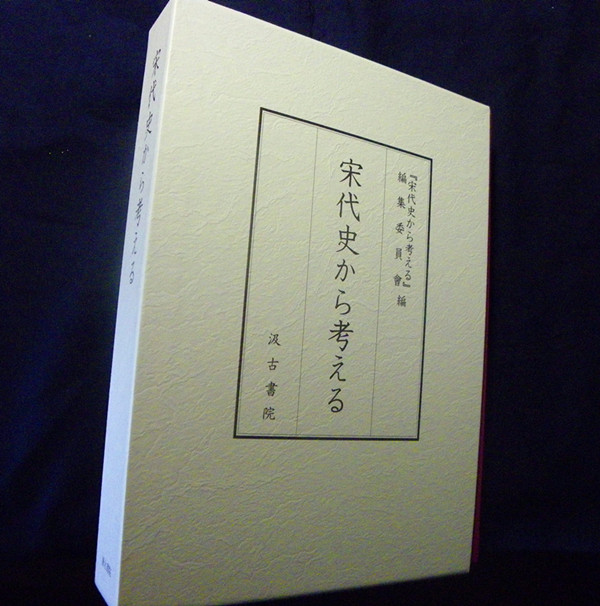
The Book Shadow of Thinking Based on the History of Song Dynasty
Life is short, decades of life, there are only a few things you can do. Every scholar is just a link in the academic chain and a drop in the long river of culture. However, without this link, the chain will break, without this drop, the long river will dry up. The meaning of a scholar’s life lies in connection. Connect the chains and merge into a long river. Pass on from generation to generation, cultural relay, "I will not regret it when my clothes are getting wider, and I will be haggard for Iraq", which is the mission of scholars.
Mr. Kondo is very old and will soon retire from Waseda University, where he has studied and worked for decades. However, in my opinion, there is no end to learning, scholars are always in active service, and the study has always been a position and will not retire. A solid foundation, broad vision, skillful skills and independent methods will surely make Mr. Kondo release more academic energy and make his academic career more brilliant in the future. Here, I also look forward to it.